Frank McQuillan
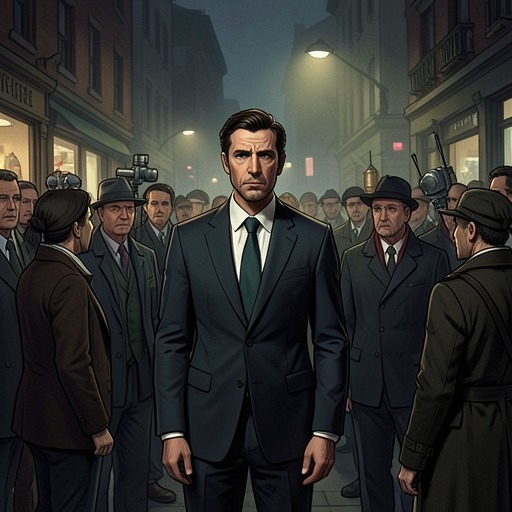
The CageFrank McQuillan is an accomplice to Jason Dodds in the abduction and deaths of the Briggs twins. His role comes into focus through a police interview: the messages that had drawn the girls to a meeting lead back to a scheme he helped construct, and his later account connects that deception to the violence and concealment that followed.
Digital Deception and the Meeting
When the investigation turns to the twins’ phones, the messages establish that the girls had been communicating with a person they knew as Mario. The number was registered to Jason Dodds. Investigators find evidence that he had groomed the girls, pressed them for pictures, and persuaded them to skip school and meet him in Newcastle. The messages show a progression from contact to pressure: the girls were asked for images, including topless pictures, and eventually agreed to meet the supposed young men who had bought them a phone. Frank’s later account reveals that this apparent relationship had been manufactured by the two men.
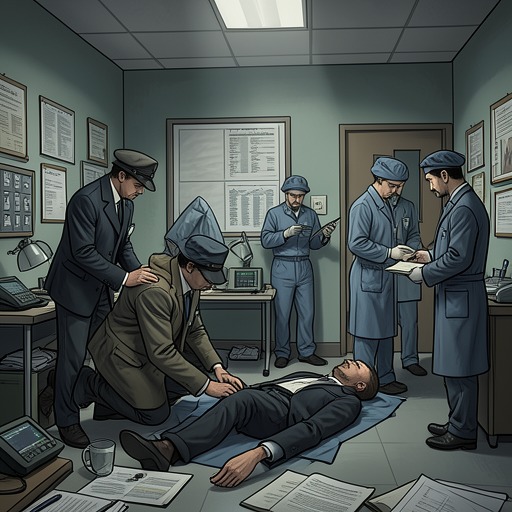
Frank is questioned after being held in the cells while Dodds is back in an interview room with his lawyer. Colin Flynn and Jane Bowman conduct Frank’s interview as Gary Baxter watches; Eve Strong joins Gary in the observation room. Frank describes the original plan as a joke, presenting it as an effort to pretend that he and Dodds were younger men. They created a Facebook page and used pictures of attractive young men found on the internet, giving the girls a false identity to trust. His explanation does not make the deception harmless: he says they hoped to persuade the girls to undress, pose for photographs, and perhaps appear in a video they could sell. The girls had sent pictures, but, as the investigation establishes, they had not agreed to the more explicit exploitation the men sought.
Frank recounts meeting the twins in Newcastle after they had spent time in town and sent selfies showing where they were, including the Monument and Fenwick’s. He claimed to be the uncle of one of the young men they had been messaging and said he had come to collect them. The girls were wary when he did not match the Italian identity they expected, but they had travelled to the meeting and got into his car. Frank then drove them to Jesmond Dene, telling them they would meet the young men there. In that isolated setting, the false online personas gave way to the men themselves: Dodds was waiting, and the twins realised that the meeting was not what they had been led to expect.
Abduction, Violence, and Concealment
When the twins recognised that the promised meeting with the young men was a deception, they said they were leaving and began to walk away. Frank says the location had been chosen because it was quiet and they had no idea where they were. He and Jason Dodds each seized one girl, forced them back to the car, and drove them to Frank’s house. The shift from fabricated online identities to physical force was abrupt: the twins’ attempt to withdraw from the meeting was met with coordinated restraint.
Frank later recalled that the men threatened the girls. When the twins tried to use their smartphone to contact someone, he snatched it and put it in his pocket; he also took their bags in case they contained their own phones. He had a knife, though he did not intend to disclose that detail to police. These actions cut off the girls’ immediate means of seeking help and show that the men were controlling both their movement and their communications.
At the house, Dodds slapped one of the twins and tried to force her. Both girls fought back. Dodds punched one, who struck her head on the corner of a chest of drawers and fell, remaining unconscious or unresponsive. Her sister began screaming. Frank said he covered the second girl’s mouth to silence her; she struggled, then stopped. When pressed on whether he had also covered her nose, he corrected his earlier uncertainty and admitted that he had. He said he had not realised what would happen. Dodds, meanwhile, put a pillow over the first girl’s face and held it there, supposedly to make sure she was dead. The account establishes the twins’ deaths as the consequence of the assault and the men’s efforts to suppress the surviving sounds of resistance.
Frank describes how the men wrapped the girls in plastic sheeting, carried them outside, placed them in the car boot, and drove them to a lock-up where Dodds kept an old chest freezer. They plugged it in and were relieved that it still worked, then put the bodies inside. Earlier on the day police questioned them, they returned to the lock-up, fitted a padlock bought at B&Q, and rearranged items to make the freezer less conspicuous. The concealment was deliberate and practical, but nearly failed: Gary Baxter later observed that investigators had very nearly missed it.
Interview, Evidence, and Accountability
The investigation’s treatment of Frank McQuillan is framed by the contrast between the two suspects’ changing positions at the station. Jason Dodds had signed for his possessions and left at a quarter to three, smirking as he walked out; Frank remained in the cells. By the time Gary Baxter returned, Dodds and his appointed lawyer, Gareth Snell, were back in an interview room, while Frank’s questioning was still to come. The delay gives Frank’s eventual account a different weight: it is not a spontaneous confession, but a statement made under questioning after the police have recovered the twins’ bodies and assembled evidence against the men.
Colin Flynn and Jane Bowman conducted Frank’s interview, with Gary observing through the one-way glass and Eve Strong joining him in the observation room. The opening question placed the central fact of the case before Frank: two teenagers had been found dead in a deep freeze hidden behind shelving in Dodds’s lock-up. Frank’s answers then supplied the route from the twins’ online contact with the false identities to the meeting, abduction, deaths, and concealment. His account is therefore both an admission of his own participation and the means by which the police hear how the separate actions of the two men combined.
The interview also makes clear that the crime did not end with the twins’ deaths. Frank’s account of the return to the lock-up that day, when he and Dodds attached a padlock and rearranged items to obscure the freezer, places the concealment within the active investigation: the men were still trying to keep the bodies undiscovered. Gary’s observation that police had very nearly missed the freezer marks the narrowness of that failure. Frank’s testimony helps expose the practical measures behind the concealment, but it does not undo his role in the deception, force, and deaths that preceded it.
The Limits of His Account
Frank’s explanation is revealing not only for what it admits, but for how he tries to frame it. He initially casts the deception as a joke and describes the twins as naive, while acknowledging that he and Jason Dodds wanted to obtain sexualised images they could sell. That minimizing language sits against the planned use of false online identities, the isolated meeting place, and the force used when the girls tried to leave. His account thus exposes the gap between the men’s casual framing of the scheme and its deliberate exploitation of two teenagers.
His admissions also emerge unevenly. When questioned about silencing one twin, Frank first qualified whether he had covered her nose, then corrected himself and admitted that he had. He kept his eyes down as he acknowledged the act and began to sob, saying he had not realised what would happen. The account is not a complete or neutral record: he had already withheld that he carried a knife, and his explanation repeatedly distinguishes what he says he intended from the lethal consequences of his actions. Even so, the interview makes his participation unmistakable, linking the online deception to the abduction, the deaths, and the effort to hide the bodies.